Many European countries were racing to stake a claim in America in the early 17th century. Spain, Portugal, and France had already set plans in motion. England was not far behind, but after their first plan failed, the Jamestown Colony was the first successful English colony in America.
For England’s second attempt, 104 people set sail from England on Dec 6, 1606. Each colony was established for different reasons. The Jamestown colony was funded by the Virginia company, who hoped the new world was a sound investment that would pay off once trade with the natives and farming had been established.
The fleet consisted of three ships: the Susan Constant, Godspeed, and Discovery. It was a long journey, and they first landed at Cape Henry.
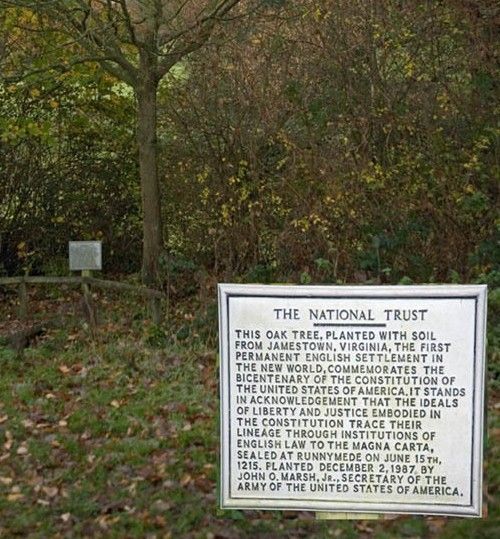
This is an oak tree planted at Runnymede during the U.S. Bicentennial celebration to commemorate Jamestown, VA, the first U.S. settlement. Image courtesy Wikimedia Commons, picture by wyrdlight.com; used with permission. We have cropped it so you can read the plaque.
The colonists landed and the first order of business was to open the sealed box sent by the Virginia company. The box contained sealed instructions for leadership in the colony and where they should set up camp. They set sail again to find a better place to set up the colony.
Anointed president by the Virginia company was Edward Maria Winfield. They also included names for a council of leadership: footholomew Gosnold, captain of the ship Christopher Newport, John Martin, John Ratcliffe, George Kendall, and John Smith.
Jamestown was strategically located. It was surrounded by water on three sides, but the water was deep enough to park their ships right off the coast. They could easily see possible attacks from the Spanish, and there were no visible signs of indian populations. The colonists didn’t know (or didn’t care) that they chose to settle down on Powhatan hunting ground.
Captain Winfield selected the land known as Jamestown on May 14. They arrived too late in the year to plant crops, and even if they hadn’t, Jamestown was surrounded by marshy swamps, thick with mosquitos.
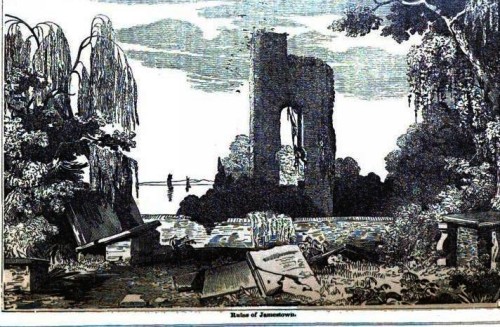
Ruins of Jamestown, VA from Robert Sears, A Pictorial Description of the United States. 1854. Public Domain. (burned down in the Civil War)
Among the daily struggles of the colonists was the threat of attack from the Spanish, the enemies of England. A Spanish reconnaissance ship stumbled across the colony at the same time a German ship arrived with supplies. The Germans defected to the Powhatans, even agreeing to join the Spanish in an attack on the colony, and convincing their newfound Powhatan allies to join them.
However, a large English supply ship arrived, much larger than the Spanish expected, and they were frightened off.
The men chosen for this expedition were not explorers. They were gentlemen who could afford the journey. Most knew little of farming, were unskilled, and had no experience with hard work. They had been ordered to trade with the natives for food and spend their time searching for precious metals. In spite of this, the triangle-shaped fort was completed June 15, 1607. It had tall defensive walls. Days after it was complete, council member and captain Christopher Newport sailed back to England for more supplies. Because they couldn’t farm, food would be needed soon.
We know now that mosquitos cause malaria, but the colonists didn’t. They soon were struck with a variety of illnesses they couldn’t account for: swelling, flux, and fever. Furthermore, they had mixed relations with the indians, who tried to relocate them off of their hunting ground. But Chief Powhatan sent gifts of food, which helped get them through until supply ships arrived.
The supply ships also brought craftsmen, and soon manufactured goods were being created to send back to the Virginia Company, which was increasingly frustrated at the lack of product. They demanded the colonists repay the cost of the voyage. John Smith wrote back insisting that if they wanted results, they needed to send craftsmen and laborers.
Pocahontas
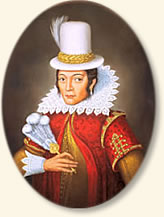
Pocahontas’ (Lady Rebecca Rolfe) official portrait
We’ve reached the point in the narrative we need to address the myths of John Smith and Pocahontas.
Disney’s tale, while based on fact, is a work of fiction. The Disney version of Pocahontas was a marriage of frontier film and Romeo and Juliet.
In truth, Pocahontas was the nickname of Matoaka, the daughter of Powhatan chief Wahunsenaca. Born about 1596, her nickname indicates she was playful and curious. Custom indicates she would have lived with her mother in different village than her father. She had many half-siblings. History doesn’t know anything about Pocahontas’ mother, but some historians have suspected she died when Pocahontas was very young, and she lived with her father instead.
Most women learned the skills necessary to survive and keep a family and contribute to the tribe (farming, building, cooking, etc.) by around 13. She was around 11 when the colonists landed.
Her first encounter with the colonists was when her uncle Opechancanough captured John Smith while he was exploring. Smith was brought before Chief Powhatan.
John Smith is not the most reliable of narrators. His tall tales were questioned even in his own lifetime. However, his is the only eyewitness account of his capture. According to Smith, two large stones were placed on the ground, his head was held on them, and a warrior hefted a massive club to smash his head in when Pocahontas laid her own head on top of his, saving his life.
Most likely, as a child, Pocahontas would never have been present at an adult religious ceremony.
Afterwards, Chief Powhatan told Smith he was part of the tribe. The exact details are unclear, but whatever occurred, Chief Powhatan began sending gifts of food to the colonists and these were usually accompanied by his favorite daughter Matoaka (Pocahontas). She became easily recognized in the colony.
These gifts were soon taken for granted and the colonists began demanding food than the Powhatan had to spare. Relations were strained.
Negotiations between John Smith and Chief Powhatan went poorly, and Chief Powhatan decreed they would no longer trade with the English. He would have killed the negotiating party, according to Smith, if Pocahontas had not warned him.
Smith was injured in a gunpowder explosion, and he returned to England for treatment. Pocahontas and her father were told he had died.
In 1610, Pocahontas married Kocoum. He was not a chief, which probably means that they married for love.
Three years later, an English captain Samuel Argall hatched a plot to kidnap Pocahontas and hold her for ransom for the return of stolen weapons and English prisoners. She was taken to an English settlement Henrico where she learned the English language and customs. Her father agreed to most of the demands to get negotiations off the ground.
Kidnapping was not unheard of. It happened between tribes. According to sacred oral history of the Mattaponi tribe, Pocahontas was submissive, but she and her father both fell into a deep depression on being separated. She suffered a nervous breakdown and her sister was sent for to care for her. Mattoponi history says she was attacked and her sister helped take care of her during her resulting pregnancy.
During her captivity, Pocahontas met John Rolfe. Here, the recorded account and the oral history diverge. Either the two fell in love, or she was a captive who was trying to create peace between her people, and she already had given birth to a half-white child. In some accounts, Pocahontas divorced Kocoum (The Indians apparently were so used to tribes kidnapping one another, they had a “divorce by capture” law. If the husband did not recapture a stolen wife, she was considered unmarried.) In another, he was killed when she was kidnapped. Her father consented to the marriage, probably because he was afraid of what would happen to her if he said no. She was baptized “Rebecca” in 1614 and married John Rolfe, which led to peace between their two cultures.
John, “Rebecca”, and their son Thomas along with a convoy of Powhatan traveled to England under the invitation of the Virginia company, who hoped this proved the venture was worthwhile and would invite investors. She saw the King and Queen and was reacquainted with John Smith.
While in England in 1617, Pocahontas died of a mysterious illness shortly after dining with Captain Argall, her original captor. She was about 21. Her son remained in England, but John Rolfe returned to Virginia to tell her father. The Powhatan who had traveled with Pocahontas told her father she had been in good health up until she died, and they suspected poison. Her father sank into depression again, and died within the year. The peace that Pocahontas had bought ended.
When John Smith returned to England following an injury, relations with the Powhantan were strained. Furthermore, even more settlers who came to help were shipwrecked and stranded, leaving more mouths to feed.
The Starving Time
The winter of 09-10 – Is known as the Starving Time. Because of the bad relationship with the Powhatan, people were afraid to leave the fort. They had been low on supplies ever since the trade with the Powhatan ceased. They first ate their supplies, then their stock animals. Eventually they were forced to eat their pets, and before the winter was out, they were eating rats, and even shoe leather. It has recently been discovered that conditions were so bad, that the people ate their fallen companions who succumbed to the cold and starvation.
Only 60 people survived the winter. That spring, stranded shipwreck survivors in Bermuda arrived. Sir Thomas Gates the replacement governor, found Jamestown dangerously low on any supplies and made the decision to abandon Jamestown. However, once they were gone, they encountered a messenger with news of an incoming fleet and a new governor, so they reluctantly returned.
The shipwreck carried one John Rolfe, who had seeds for a new strain of tobacco from Spain. Unlike the common tobacco, this one tasted sweet when it was smoked. He soon organized the plants into a profitable crop, which was exactly what the Virginia company was looking for in the colony.
Tobacco was a profitable crop, but it was also the beginning of a moral decay in America that wouldn’t end until the 1800’s. The new farming venture required workers, and so tobacco crops mark the first documented slavery in the United States in 1619. Intending to make Jamestown a flourishing city, the Virginia Company sent a shipload of women over to become wives and mothers.
Peace with the Powhatan Ends
The tenuous peace with the Powhatan tribe broke when Pocahontas’ father died. His successor, his brother Opechancanough, may have blamed his and Pocahontas’ death on the English. He organized an attack on the settlement. However, they received warning, and many survived, but it was a significant blow.
In the midst of the constant fight for their lives, the Virginia company’s charter was revoked, passing the colony into the hands of the monarchy. The Jamestown Colony would remain a Royal colony until the Revolutionary War, more than 100 years later.
Two years after the first indian attack, there was another with devastating consequences. Another 400 settlers died, and Opechancanough was captured and shot (against orders), ending the fighting. His successor signed a treaty with the colonists, making his tribe of Powhatans indians subjects of the English.
Bacon’s Rebellion
This peace with the native Americans lasted about 30 years. The tobacco cash crop was pretty successful, and the colonists began to resent the fact that it could only be sold to the English. The restrictive trade meant the English had full control of the price being paid for it under the Navigation Acts. Furthermore, several indian tribes who had not sworn loyalty to the king were continually attacking outlying farms.
As tends to be the case in history, people were upset and didn’t differentiate between friendly tribes and non-friendly tribes and instead began to spread angry rhetoric against “the Indian problem.”
One particularly charismatic farmer Nathaniel Bacon gathered together 1000 men to help him take care of “the problem.” He convinced the colony’s leader Governor Berkeley to grant him permission to attack the indians who were burning their outer farms, but once he had his permission, he attacked without discrimination.
Governor Berkeley denounced Bacon as a rebel, and high tensions split the colony into civil war. Bacon and his men set fire to the colony, destroying 20 buildings before Nathaniel Bacon died of the bloody flux. Without their leader, his movement disintegrated and many were captured and hanged.
A second treaty was signed, by even more tribes than the first, requiring annual tributes from the indians to the English.
Moving to Williamsburg
Jamestown ceased to be the capitol of the colony when another fire swept the city. In 1699, the government buildings were transferred to Williamsburg. Williamsburg and Jamestown are both historic sites and visitors today can see what life was like for the colonists.