
“I only regret that I have but one life to give for my country.”
Nathan Hale was cut out to be a military man. Five of his brothers fought at the battles of Lexington and Concord.
Young Nathan soon joined them. Having graduated with honors from Yale university at the tender age of 18, he was given the rank of 1st Lieutenant when he joined the Continental Army. In a matter of months, he was promoted to Captain and given command of a group of Rangers defending New York City.
In July of 1776, the British began building up troops on Staten Island. Because the British navy controlled the waters around New York, there was nothing the Americans could do to prevent this.
On August 22, British troops, under the command of General William Howe landed on Long Island to begin their conquest of New York. The Americans lost the Battle of Long Island on August 27 and by September 15 the British were in full control of New York City.
Nathan Hale, the Spy
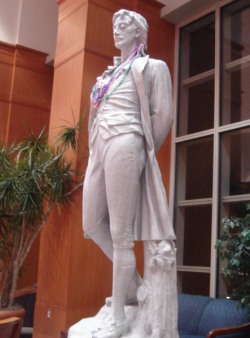
Statue of Nathan Hale
Hale is not remembered for his success as a spy. He spent just over a week pretending to be a school teacher—his occupation before the war—then made his way back to an appointed meeting place at Oyster Bay. Seeing a boat arrive, he assumed it was his American compatriots and waved it down.
Unfortunately, it proved to be a British frigate, and he was caught as he fled. Papers hidden on his person, with notes from his week of spying, proved his undoing. He was arrested and brought to General Howe.
The very next day, New York City burned. The English assumed that the Americans had set it on fire, though to this day no one knows whether that is true. Two hundered Americans were rounded up and jailed.
Nathan Hale, proven to be a spy by the papers on his person, was sentenced to be hanged the very next day.
It is for this that he is remembered. His tragic end would inspire a nation, and he is remembered more as a martyr than as a spy.
Captain Nathan Hale, the Consummate Patriot
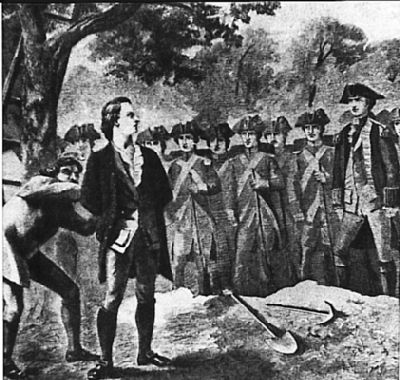
The famous words, I only regret that I have but one life to give for my country, were just the start of Hale’s bravery. Captain Montresor, an English officer, testified that after reading letters Nathan had written to his mother and an American officer, the British refused to send them. The reason, he said, was the the Provost Marshal did not want the Americans to know “that they had a man in the army who could die with so much firmness.”
On the morning of hanging, Hale was given an opportunity to make a dying speech. By every account, it was moving.
- British officer Frederick MacKensie wrote in his diary, “He behaved with great composure and resolution.” He added that Hale encouraged the spectators to “meet death in whatever shape it might appear.”
- The Essex Journal reported: “He made a sensible and spirited speech.” They quoted him as saying, “If I had ten thousand lives, I would lay them all down in defense of this injured, bleeding country.”
- The Independent Chronicle and the Universal Advertiser reported him as saying: “I am so satisfied with the cause in which I have engaged, that my only regret is that I have not more lives than one to offer in its service.”
Perhaps Edward Everett Hale, Nathan Hale’s great nephew, summed up his legacy best: “Because that boy said those words, and because he died, thousands of other young men have given their lives to this country.”