It’s impossible to know all the causes of the American Revolution. This page will cover what we do know.
In the beginning, the colonies were proud to be British. There were small instances of Parliament’s control that bothered the colonists, like the Currency Acts of 1751 and 1764. But when the French and Indian War took place (1754 – 1763), King George III lost a great deal of money due to buying expensive supplies for his army and the colonies. In order to pay off his debt, he imposed taxes on the colonies without their consent.
This outraged the colonists.
It’s an old saying that you should always look for the money trail. The Protestant Reformation had one, and money was certainly one of the major causes of the American Revolution.
The colonists did not like being taxed for things that had always had free. They immediately began a boycott of British goods.
Now it was the king’s turn to be furious.
King George wasted no time in sending soldiers across the Atlantic to make sure the colonies were behaving as they should.
Soon, what is perhaps the most famous of the causes of the American Revolution came to pass. A young ship owner brought over a ship full of taxed tea from Britain and declared he would see it unloaded …
Causes of the American Revolution:
The Boston Tea Party
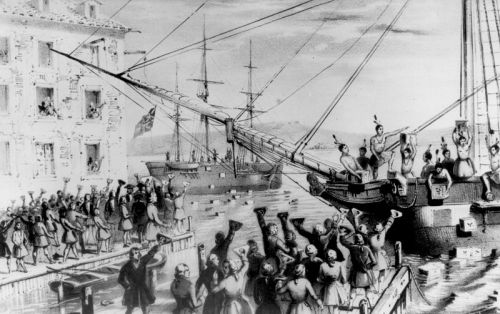
The colonists decided they would see none of the tea leave the ship. A group of colonists dressed as American Indians boarded the ship at night and threw the tea overboard into the harbor, ruining all of it. When they saw one of their comrades trying to stuff some in his pockets, they stripped the tea from his grasp and sent him home without his pants. They then stripped the ship owner of his clothes and tarred and feathered him.
This event is now known as the Boston tea party.
I can’t resist reminding you of Mr. Banks’ comment in the movie Mary Poppins that when the tea was thrown into the harbor, it became “too weak for even Americans to drink.”
Causes of the American Revolution:
The Intolerable Acts
In response to the Boston Tea Party, the king imposed the “Intolerable Acts.”
One of the more major causes of the American Revolution, the Intolerable Acts were …
- The Boston Port Act, closing the port of Boston until the Dutch East India Company had been repaid for the destroyed tea;
- The Massachusetts Government Act, putting the government of Massachussets almost entirely under direct British control;
- The Administration of Justice Act, allowing royal officials to be tried in Britain if the king felt it necessary for fair justice;
- The Quartering Act, ordering the colonies to provide lodging for British soldiers
- The Quebec Act, expanding British territory in Canada and guaranteeing the free practice of Roman Catholicism.
The Quartering Act incensed the colonies most. The king and parliament revived an old law requiring colonists to house British soldiers in their homes. Because of the Boston Massacre (4 years earlier, in 1770), the colonists were afraid of the soldiers in their homes. They would lay awake at night with fear for their children embedded in their hearts like a knife.
This is when the colonies decided that something must be done.
Causes of the American Revolution:
The First Continental Congress
Out of the Intolerable Acts the First Continental Congress was born.
In this congress 55 delegates representing 12 of the 13 colonies—Georgia withheld—argued back and forth as to whether or not they should separate from Britain for killing their people, firing cannons on their cities, closing down Boston’s sea port, and, primarily, imposing the intolerable acts.
The congress was in session for two solid months in September and October of 1774. After much dissension, they decided to send a “Declaration of Rights and Grievances” to King George, hoping their demands would be met. At this point, the colonists still could not foresee separating from Britain.
More ominously, they also endorsed the “Suffolk Reserves,” resolutions passed by Suffolk county in Massachusetts—certainly one of the causes of the American Revolution.
Massachusetts was the colony worst hit by the Intolerable Acts. The Suffolk Reserves warned General Thomas Gage that Massachussets would not tolerate their enforcement and that they would retain possession of all taxes collected in Massachusetts.
After sending the Declaration of Rights and Grievances, the First Continental Congress separated to await Britain’s reply.
Causes of the American Revolution:
The Battles of Lexington and Concord
Tension was far too high for the king to respond favorably. The colonists began to amass arms and prepare for what they felt was an inevitable battle with the oppressive British army.
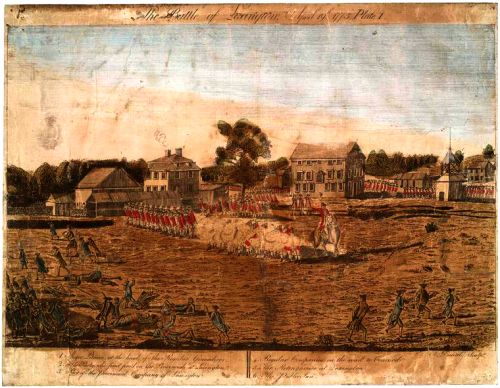
It came soon enough. Paul Revere’s ride on April 19, 1775 was to announce the approach of British soldiers to stamp out colonist resistance in the towns of Lexington and Concord.
Lexington was first. The British met only 77 minutemen, and at first were pleased to allow them to leave. However, from some unknown place a shot was fired, and the British opened up on the Americans. Eight were killed, ten wounded, and the British suffered but one minor casualty.
It was made up for at Concord. There the colonists were prepared.
400 minutemen sent the British troops scurrying back to Lexington, completely unprepared to be fired on from the woods during their retreat. Apparently, guerilla tactics were considered ungentleman-like in that day and age.
Ungentlemanly or not, they were effective, and the Americans routed the British all the way back to Boston. There were nearly 300 British casualties, including 73 dead and 23 missing. The Americans suffered less than 100.
Causes of the American Revolution:
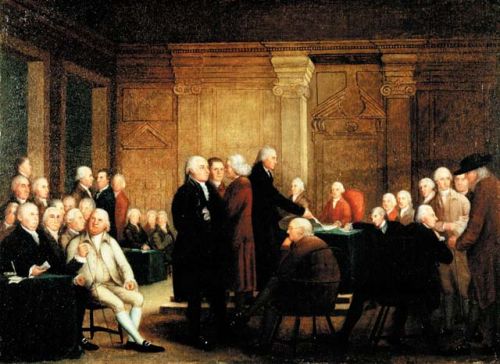
The Second Continental Congress
It was time to do something. The Continental Congress gathered again in May of 1775, where they would become and remain the government of the colonies until the end of the Revolutionary War.
They quickly made an attempt at peace, sending the Olive Branch Petition to King George declaring their loyalty. When it reached the King he pushed it aside and didn’t even read it, and in response he sent a proclamation to the Congress saying that they would all hang for their defiance to the crown.
The Olive Branch Petition
I thought you might be interested in the proposition the 2nd Continental Congress made to King George III:
“Attached to your Majesty’s person, family, and Government, with all devotion that principle and affection can inspire; connected with Great Britain by the strongest ties that can unite societies, and deploring every event that tends in any degree to weaken them, we solemnly assure your Majesty, that we not only most ardently desire the former harmony between her and these Colonies may be restored, but that a concord may be established between them upon so firm a basis as to perpetuate its blessings, uninterrupted by any future dissensions, to succeeding generations in both countries, and to transmit your Majesty’s name to posterity.”
This united the colonies and birthed the Declaration of Independence, which bore us to war with Britain.
And there you have the causes of the American Revolution.